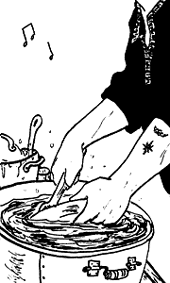
Driftwood 7 05
November 26th, 2008
This episode was partly inspired by some East European ghost story I read many, many years ago.
Comments Off on Driftwood 7 05


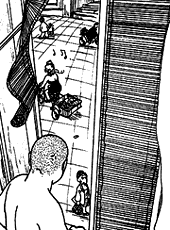
This episode was partly inspired by some East European ghost story I read many, many years ago.
Not very surprisingly, Eva and Aeron have very different conceptions of their mum …
(I was actually so out of it when I lettered this in Photoshop that I lettered the whole page 2 in Swedish before I realised that I was supposed to translate it into English.)
¤ ¤ ¤
Yes, Aeron says “inherit all his property”. They were born around the revolution, and though their dad went to fight and die in the civil war, the revolution didn’t really spread to their remote area – somewhere on the vast steppes north of the Caspian Sea – until years later. While they were young, private property and social differences were still common in their area. Aeron was sent to work for a big landowner, and Eva was almost married off to another big landowner. However, in the 1930’s things changed very dramatically, but by then Aeron and Eva had both run away on their own.
¤ ¤ ¤
I’m actually a bit paedagogic here, because I provided a pronunciation guide for their dad’s name, Oleg. (You can hear it pronounced by real Russian speakers at the end of this nice video.) I have a half finished little info comic where Aeron and Eva explain all about the great wonders of Russian names. Until then, here are the names and pet names that Aeron and Eva go by:
First name, patronymic, surname: Aeron Olegovitch Sanin
Pet names: Ronya, Ronyuk.
“Aeron” is pronounced [a-uh–ron]. Russians would probably confuse it with Aaron/Aharon, which sounds the same. But his name actually comes from an obscure Byzantine saint whom their babushka was a big fan of. (By the way, “babushka” is pronounced [bah-bushka] – I hate it when people put the emphasis on the second syllable and make fun of it …)
“Sanin” [sah-nin] is a surname derived from the first name “Aleksandr”, via the diminutive form “Sanya”, in a similar way as surnames like Sanyutin, Sashenkov, Sahnevitch or Sashkov. (It could also be that it’s actually derived from the first name “Aleksei”, as it shares many diminutive forms with “Aleksandr”.)
First name, patronymic, surname: Yevdokiya Olegovna Sanina
Pet names: Yevdokeyushka, Dunya, Dusya, Dunyechka.
“Yevdokiya” is pronounced [yivda-ki-yah]. It’s also of Greek/Byzantine origin, meaning “to seem well”. But, as opposed to “Aeron”, there really are people with that name in Russia, though it’s considered old-fashioned and weird today.
Translation notes:
It appears that the English “dog watch” in nautical terminology is a different watch from the Swedish and German “hundvakt”/”Hundewache”. In Swedish and German, it’s the watch from 00.00 to 04.00. In German, it also goes under the name of “Rattenwache” or “Schweinewache” (“Rat’s watch”, “Pig’s watch”). It’s generally regarded as the least desirable watch of the day, because neither in the evening nor in the morning can you catch enough sleep (there is, of course, other work to do during the day).
In English, however, the “dog watch” is often the watch from 16.00 to 20.00, which is divided into two half watches (first dog watch, last dog watch), which prevents the same people from working the same watch every day. In Wikipedia, it is speculated that “the name is thought to have come from the fact that someone tasked with one of these ‘half’ watches was said to be ‘dodging the watch’, taking or standing the ‘dodge watch’. This became shortened to ‘dog watch’.” In Swedish, on the other hand, this watch is called “Plattvakt“.
But it appears that in a different English watch system, the dog watch is 02.00 to 06.00. From what I can see on teh Intarwebs, this system seems to be used in many yacht races today. (That type of dog watch is also the watch I had when I worked as a morning paper distributor … And I didn’t get any dodge watches, no sir. But I really enjoyed being awake while everyone else was asleep.